The Frequency Meter Node (FrequencyMeterNode) analyzes an Audio FFT stream and turns selected frequency energy into values that can drive fixtures, gates, colors, and animations.
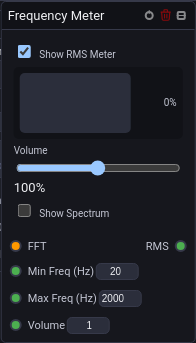
🎚️ Analysis Modes
- Parametric: Measures the range between Min Freq (Hz) and Max Freq (Hz) and returns one RMS value. Use this for a focused kick, vocal, bass, or effect range.
- Fixed: Splits the
20 Hz–20 kHzspectrum into eight logarithmic bands. Choose a3 dB/octor4.5 dB/octslope, then use the individual band outputs or the complete Bands array.
The Volume input applies a 0–200% gain before the selected measurement is calculated. The Spectrum display can be enabled in either mode: parametric mode highlights the selected passband, while fixed mode marks all eight fixed bands and labels their centers.
🔌 Sockets Reference
| Socket | Mode | Direction | Data Type | Description |
|---|---|---|---|---|
| FFT | Both | Input | Audio |
Raw FFT stream from an Audio Input Node. |
| Min Freq (Hz) | Parametric | Input | Number |
Lower edge of the measured range, from 20 to 20000 Hz. |
| Max Freq (Hz) | Parametric | Input | Number |
Upper edge of the measured range, from 20 to 20000 Hz. |
| Volume | Both | Input | Number |
Analysis gain from 0 to 2. |
| RMS | Parametric | Output | Number |
Energy level inside the selected range (0.0–1.0). |
| 32, 75, 180, 420, 1k, 2.4k, 5.6k, 13k | Fixed | Output | Number |
Energy level for each fixed logarithmic band. |
| Bands | Fixed | Output | Number Array |
The eight fixed-band levels in low-to-high order. |
💡 Practical Stage Recipes
- Sub-Bass Flash: Use Parametric mode with
40–100 Hz, connect RMS to a Gate Node, and route the envelope to a strobe or dimmer. - Eight-Band Colorizer: Use Fixed mode and connect individual band outputs to Math or Color logic for a multi-band effect.
- Live Spectrum Debugging: Enable Spectrum while tuning the frequency range. The guides show where the passband sits against the live FFT curve.