Live concert touring and DJ performances are fundamentally non-linear: operators busk on the fly using faders, flash pads, and audio-reactive macros. In contrast, theatrical drama, opera, musicals, and corporate keynotes demand a strictly structured, reproducible sequence. Every lighting shift is anchored to a specific line of dialogue, an actor's entrance, or an offstage audio effect.
Unilighter accommodates both paradigms. Within the Functions Widget, operators can switch between freeform button grids, traditional sequential Cue Lists, and an industry-first Theatrical Scenario Script Mode.
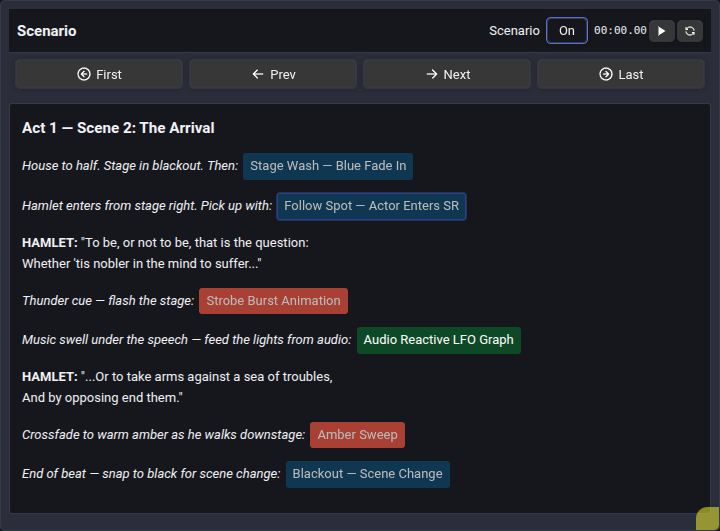
🎭 The Three Operating Modes of Functions Widget
When editing a Functions Widget on the Live Dashboard, open widget settings to toggle between three distinct workflow modes:
| Mode | Target Workflow | Primary Controls |
|---|---|---|
buttons |
Live concert busking, festivals, DJ sets | Grid of momentary or toggle buttons for scenes, chases, and node graphs. |
cue-list |
Theatrical drama, dance performances | Linear cue stacks with Cue numbers, Go / Back / Pause transport, and fade times. |
scenario |
Screenplay reading, drama rehearsals, timed shows | Full rich-text script view with inline cue badges and built-in stopwatch. |
📜 Theatrical Scenario Script Mode
In traditional theater booths, the lighting operator must juggle a paper script binder on their lap while keeping their fingers on the console's Go button. If the cast skips a line or jumps ahead during a live rehearsal, synchronizing the cue stack becomes stressful.
Scenario Script Mode solves this by embedding the play's screenplay directly into the digital control console:
1. Rich Text Play Script
Lighting designers or stage managers can paste the complete screenplay (dialogue, act/scene headings, character names, and italicized stage directions) directly into the widget editor.
2. Inline Interactive Cue Badges (<function>)
Lighting states are embedded directly inside the dialogue as clickable badges:
- Scene Badges (blue): Static looks such as Stage Wash — Blue Fade In or Blackout.
- Animation Badges (red): Dynamic movement such as Strobe Burst Animation or Amber Sweep.
- Node Graph Badges (green): Procedural sound-to-light or wave automation such as Audio Reactive LFO Graph.
Clicking any inline badge immediately fires that cue, allowing operators to trigger changes intuitively right as the actor utters the cue word.
3. Integrated Live Stopwatch
A built-in digital timer (00:00.00) with Play, Pause, and Reset controls sits in the widget header. This enables stage managers and operators to track exact scene durations during technical runs and dress rehearsals.
4. Sequential Rehearsal Navigation
The navigation header provides dedicated step controls:
|◂ First: Jumps to the opening cue of the production.◂ Prev: Steps backward to the previous cue in the script.Next ▸: Advances to the upcoming cue.Last ▸|: Advances directly to the show finale.
⏱️ Crossfades & Transition Settings
In theatrical lighting, snap transitions can ruin an intimate dramatic moment. Right-clicking or clicking the transition icon on any scenario cue badge opens the Transition Editor:
- Crossfade Duration: Define exact transition times in seconds or milliseconds (e.g.
3.5sslow evening fade-out vs.0.2slightning strike). - Easing Curves: Select between linear crossfades, smooth S-curves (
Ease In / Out), or exponential fades. - Hold & Release: Configure whether a triggered look holds indefinitely until superseded by a higher-priority cue, or releases automatically upon completion.
🎛️ Standard Sequential Cue Lists
For venues that prefer standard theater numbering, the cue-list mode organizes cues into a vertical stack:
- Cue Indexing: Decimal numbering (
Cue 1.0,Cue 1.5,Cue 2.0). - Split Fade Times: Independent fade-in times for incoming fixtures and fade-out times for outgoing fixtures.
- Auto-Follow Timers: Automatically fire subsequent cues after a preset delay without requiring a second manual Go button press.
Read more in the Live Dashboard Guide and the Function Widget Manual.