The Gate Node (GateNode) acts as a dynamic ADSR-style envelope filter and peak trigger. It passes incoming signals only when they exceed a configurable threshold, smoothing transients with Attack and Release timings across scalar or multi-element sequence streams.
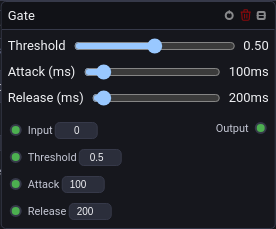
⏱️ Dynamic Envelope Parameters
- Threshold (0.0 – 1.0): Minimum input signal level required to open the gate.
- Attack (ms): Time required for the output to reach 100% after the threshold is crossed (e.g.
5msfor instant flash,200msfor smooth swell). - Release (ms): Decay time for the output to fade back to zero after the input drops below the threshold. Eliminates harsh flicker and creates natural light decays.
🌊 Sequence Support & Independent Element Envelopes
GateNode natively supports sequences on its Signal In socket:
- Polymorphic Signal Processing: When fed a single number, it operates as a standard scalar envelope follower. When fed a sequence, it automatically processes each element in the array.
- Independent State Tracking: Envelope state (current attack/decay ramp position) is tracked independently for each element in the sequence. A peak transient on element 0 will not open or reset the decay curve of element 3.
- Uniform Temporal Dynamics: The
Threshold,Attack, andReleaseinputs remain scalar to ensure uniform envelope dynamics across all fixtures in a tag.
🔌 Sockets Reference
| Socket | Direction | Data Type | Description |
|---|---|---|---|
| Signal In | Input | Number / Sequence |
Continuous incoming signal (scalar or sequence). |
| Threshold | Input | Number |
Scalar opening threshold (0.0 – 1.0). |
| Attack | Input | Number |
Rise time in milliseconds. |
| Release | Input | Number |
Fall decay time in milliseconds. |
| Gate Out | Output | Number / Sequence |
Smoothed envelope signal matching input shape. |
| Trigger | Output | Trigger |
Boolean pulse emitted at the moment of gate opening. |