As lighting projects evolve from basic chasers into full-scale concert rigs, node graphs can easily turn into tangled webs of duplicate signal chains. If you need three independent sound-reactive strobe pulse lines, building three identical sets of audio bandpass filters, envelope followers, and math multipliers clutters the canvas and makes show maintenance difficult. Subgraphs (reusable function graphs) let you package entire node networks into neat, modular building blocks with custom inputs and outputs.
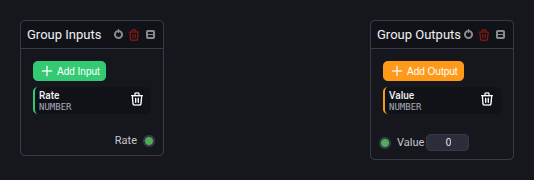
🧱 The Subgraph Interface Architecture
A reusable subgraph operates like a programming function: it receives parameters through its inputs, executes an internal graph, and streams results through its outputs.
1. Group Inputs Node (GroupInputsNode)
- The Entry Boundary: Represents the input parameters passed into your custom composite node.
- Declaring Custom Sockets: Click + Add Input to declare an exposed socket.
- Parameter Naming & Types: Assign a descriptive parameter name (e.g. Rate, Pulse Width, Base Color, Sensitivity, Sequence Offset) and select its data type:
Number: Scalar float or integer value.Sequence: Numeric array (number-array) up to 64 elements.Number or Sequence: Polymorphic socket accepting either a scalar or a sequence dynamically.Color: RGB/HSL color data.Boolean: On/off flag.Trigger: Momentary impulse pulse.
- Default Fallbacks: Set default numeric, sequence, or color values used whenever an exterior wire is disconnected.
2. Group Outputs Node (GroupOutputsNode)
- The Exit Boundary: Represents the calculated signals returning from your internal graph.
- Declaring Output Pins: Click + Add Output to declare the output pins your collapsed node will expose to exterior graphs (e.g. Strobe Pulse, Pan Angle, Tilt Angle, Chasing Pattern, Master Output). Supports
Number,Sequence,Number or Sequence,Color,Boolean, andTrigger.
📦 Encapsulating & Reusing Graphs
- Clean Single-Card Abstraction: In exterior parent graphs, a subgraph appears as a compact, self-contained node card displaying only your named custom sockets.
- Encapsulated Scope: Internal math equations, intermediate delay lines, envelope followers, and routing nodes stay cleanly hidden inside the subgraph.
- Project Portability: Save custom function graphs into your local project library. Using the Import Graph modal, you can drop your battle-tested function nodes (such as a custom moving head Lissajous ballyhoo generator, procedural sequence chaser, or multi-band audio colorizer) into any new show project in seconds.
💡 Practical Recipe: Building a Sound-to-Light Strobe Macro
- Open a new node graph named
Macro - Kick Strobe. - Add a Group Inputs Node with two inputs:
Sensitivity(Number, default0.5) andDecay Time(Number, default120ms). - Wire incoming audio through an Audio Input Node, into a Frequency Meter tuned to kick drum frequencies (
45–90 Hz). - Pass the filtered energy into a Gate Node, connecting the
Sensitivityinput to the gate threshold andDecay Timeto the release envelope. - Connect the gate output into a Group Outputs Node with an output socket named
Strobe Intensity. - In your live performance graph, instantiate this composite macro. You now have a tidy, single-card Kick Strobe node with just two intuitive slider controls!
Read more in the Visual Node Graphs Guide.