In traditional lighting desks, grouping fixtures requires building rigid submasters or hardcoded group numbers. If a fixture is swapped out during a tour or re-rigged on a different truss, operators have to hunt down and update every cue and submaster individually.
Unilighter replaces rigid submasters with a dynamic, non-destructive Fixture Tags architecture. Any fixture can carry multiple semantic tags simultaneously, bridging setup addressing, live dashboard control, timeline choreography, and procedural node logic into one flexible system.
🏷️ Multi-Dimensional Tag Taxonomy
Because fixtures are not limited to a single group, lighting designers can tag rigs across multiple operational dimensions:
| Tag Dimension | Example Tags | Primary Use Case |
|---|---|---|
| Physical Stage Zone | #FrontStage, #BackTruss, #FloorLeft, #AudienceBalcony |
Positioning, focus walking, spatial wave choreography. |
| Optical Fixture Type | #Beams, #Washes, #Strobes, #BlindBars |
Master dimmer control, synchronized strobe flashes. |
| Show Role / Cue Group | #BandSpecials, #KeyLight, #CrowdBlinders, #Worklights |
Quick busking triggers, emergency worklight isolation. |
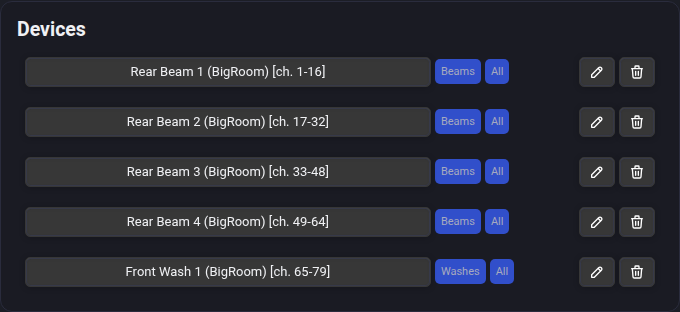
To assign tags, navigate to Device Patch (/#/setup), click any fixture, and type tag names in the tag input field. Tags appear as colored chips next to fixture names throughout the entire console.
⚡ Where Tags Power the Console
1. Device Control Widgets (Tag Mode)
Switching a Device Control widget to Tag Mode allows a single card to control dozens of fixtures simultaneously:
- Moving the Pan/Tilt XY pad steers the entire
#Beamsgroup in unison. - Selecting a color on the color wheel broadcasts normalized HSV values to all tagged wash fixtures, automatically handling mixed RGB and RGBW diode engines via the Color Engine. Indexed color-wheel presets and custom raw DMX wheel positions are also broadcast to every fixture in the tag.
2. Handling Inconsistent Values (Inconsistency Badge)
When multiple fixtures in a tag group have conflicting parameter values (for example, if some beams are pointed stage-left and others stage-right, or dimmers are at different levels):
- Unilighter highlights the parameter with a yellow Inconsistency Badge displaying the number of conflicting fixtures.
- Adjusting the fader or dial brings all fixtures smoothly into unison or trims them proportionally.
3. Procedural Automation in Node Graphs (DeviceNode)
 Setting Control Mode: Tag on a
 DeviceNode routes dynamic LFO wave generators, audio FFT kick pulses, or mathematical equations to an entire fixture array through a single node wire.
4. Sub-Emitter & Multi-Head Targeting
For pixel battons and ring-wash heads detailed in the Multi-Head Architecture Manual, tags address both global units and individual cells:
- Target
#PixelBarsto set color across all heads. - Target
#PixelBars.sharedto adjust physical tilt without touching colors. - Target
#PixelBars.h0to isolate the leading edge pixel across all bars.
🎪 The Touring & Rig Swap Advantage
The true power of semantic tags becomes evident during live tour maintenance:
If a moving head fails during an afternoon soundcheck, a technician can replace it with a spare unit, patch it to an open DMX address on any universe, and simply assign the #Beams tag.
Because Unilighter's scenes, animations, dashboard widgets, and node graphs target #Beams rather than a hardcoded DMX channel number, the replacement light is instantly integrated into the entire show file—without reprogramming a single cue or animation track.
Read more in the Device Patch Manual and the Control Priorities & Layering Guide.