The Audio Input Node (AudioNode) captures live audio and publishes a real-time Fast Fourier Transform (FFT) stream for reactive lighting.
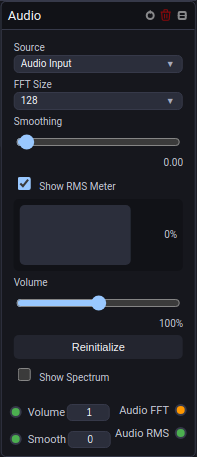
⚙️ Configuration Parameters & Controls
- Source: Choose Microphone for a selected system input or Screen Audio to capture audio offered by a screen-share source. The Audio Input option is reserved for host-specific input handling.
- Input Device: When Microphone is selected, choose the available audio input device or Default Device.
- FFT Size: Choose
128,256,512,1024,2048,4096, or8192. Larger sizes provide finer frequency resolution; smaller sizes react with a shorter analysis window. - Smoothing: Applies temporal smoothing from
0.00to0.99. Lower values preserve fast transients, while higher values make the displayed spectrum and downstream response steadier. - Volume: Applies an analysis gain from
0%to200%before the signal is used by downstream nodes. - RMS Meter: Shows the current overall signal level as a percentage when enabled.
- Spectrum: Shows the live spectrum with a logarithmic frequency axis, readable frequency labels from
20 Hzto20 kHz, and level guides from-20 dBto-100 dB. - Reinitialize: Reopens the audio context after a browser permission change or a suspended audio session.
🔌 Socket Outputs Reference
| Output Socket | Data Type | Description |
|---|---|---|
| Audio FFT | Audio |
Raw FFT data together with the sample rate and FFT size. Connect this to a Frequency Meter Node or BPM Node. |
| Audio RMS | Number |
Overall root-mean-square level of the incoming audio signal. |
The Audio Input Node does not provide separate Bass, Mid, or Treble sockets. Use a Frequency Meter Node when you need a selected band or a bank of fixed bands.
💡 Practical Stage Recipes
- Bass Kick Strobe Pulse: Connect Audio FFT to a Frequency Meter, select Parametric mode, set a kick-drum range such as
40–100 Hz, and route RMS through a Gate Node to a strobe parameter. - Beat-Synchronized Effects: Connect Audio FFT to the BPM Node and use its frequency or trigger output to drive an animation or node graph.
- Smooth Ambient Response: Connect Audio RMS through a Gate Node or Math node and map the result to the dimmer of a wash tag.