Lesson 1.1: Luminaire Types & Optics: PARs, Bars, Wash, Spot, Beam & Profiles
When you walk onto a stage, you see metal enclosures and motorized heads hanging from aluminum trusses. To a casual observer, they are simply "lights." To a lighting designer, each luminaire is a distinct optical instrument with a specific beam angle, edge definition, and visual role.
Choosing the wrong fixture for a task causes immediate visual problems. If you try to illuminate an acoustic singer's face with an ultra-narrow beam moving head, you will blind the performer with an uncomfortable pinspot while leaving the rest of the stage in darkness. If you try to create sharp aerial beam patterns with wide wash fixtures, the beams melt into an indistinct haze cloud.
This lesson covers the primary fixture families, explores their internal optical mechanisms, and explains where to hang them on a stage rig.
1. Static Stage Fixtures
Static fixtures have no motorized pan/tilt motion. Once a technician mounts them on a pipe or floor stand, angles them toward a target, and locks the bracket bolt, their position remains fixed throughout the production.
1.1 PAR Cans (Parabolic Aluminized Reflector)
The PAR can is the classic workhorse of concert and theatrical lighting. Historically, it consisted of a lightweight spun-aluminum cylinder holding a sealed-beam incandescent lamp (similar to a vintage aircraft or locomotive headlight).

- Modern LED PARs: In modern venues, incandescent lamps have largely been superseded by LED PARs featuring Red, Green, Blue, and White (RGBW) or Amber (RGBA) emitter clusters, or single Chip-on-Board (COB) sources with smooth color blending.
- Optical Character: Soft, oval or round beam with gentle, gradual falloff toward the edges.
- Primary Roles: Overhead color washes, architectural uplighting against venue walls and pillars, and warm backlighting on musicians.
1.2 LED Bars & Battens (Pixel Strips)
An LED bar contains a linear row of high-power LEDs housed in a rigid rectangular casing, typically 0.5 to 1 meter in length.
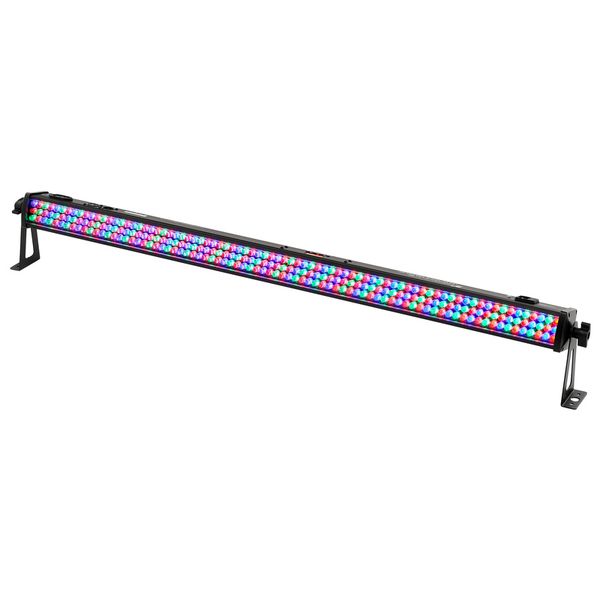
- Pixel Mapping: Many bars allow independent control over each individual LED cell (e.g. 8, 12, or 16 separate RGB segments along the fixture).
- Optical Character: A wide, linear fan of light.
- Primary Roles: Grazing backdrops and drapes from the floor, serving as footlights along the downstage edge, or generating horizontal chase animations behind a band or DJ booth.
1.3 Audience Blinders & Strobes
High-energy live performances rely on punchy momentary accents:
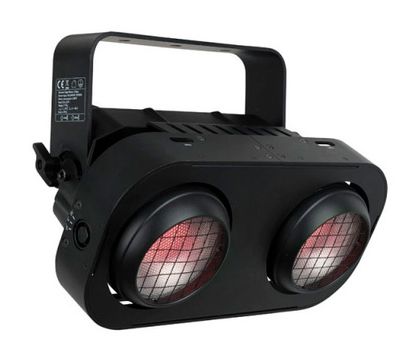
- Audience Blinders (Molefays): Banks of 2 or 4 high-wattage warm tungsten lamps (or modern high-output warm-white COB LEDs). They point directly outward toward the crowd during musical peaks and chorus drops to illuminate the entire venue and connect the performer with the audience.
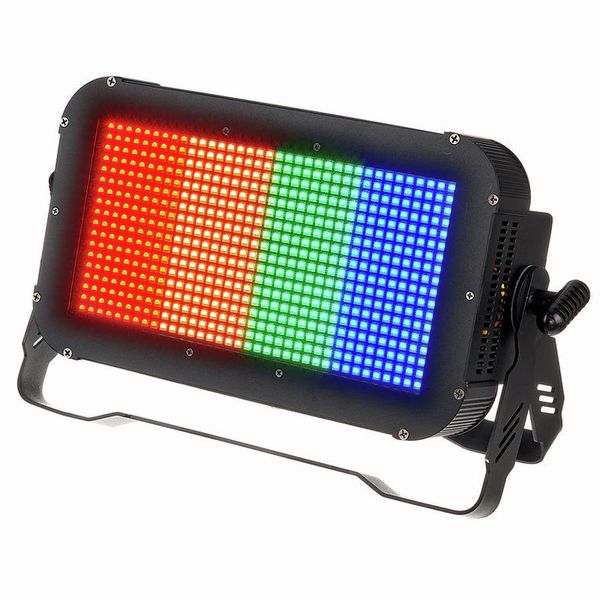
- High-Power LED Strobes: Fixtures engineered to produce short, intense flashes of light (a few milliseconds per burst). Modern LED strobe panels can also double as continuous floodlights and pixel-mapped color matrices.
2. Automated Moving Heads
Automated moving heads feature internal stepper motors that rotate the fixture horizontally (Pan, typically 540 degrees) and vertically (Tilt, typically 270 degrees).
Inside the head, the optical train determines whether the fixture produces a soft pool of light, a projected graphic shape, or a laser-like shaft. Moving heads divide into four main optical categories:
Optical Comparison Table
| Type | Beam Angle | Edge Definition | Internal Tools | Best Production Role |
|---|---|---|---|---|
| Wash | Wide (15° to 60°) | Soft, blended edge | Motorized zoom, smooth color mixing (RGBW / CMY) | Bathing performers, bands, or backdrops in smooth, seamless color |
| Spot | Medium (10° to 30°) | Crisp, sharp edge | Metal/glass gobos, rotating prisms, motorized iris, zoom/focus | Projecting floor breakup patterns, logos, and crisp performer spots |
| Beam | Ultra-narrow (1° to 4°) | Razor-sharp shaft | Color wheels, high-speed prisms, frost filter | Concentrated mid-air aerial beams cutting through haze for concert energy |
| Profile | Variable (10° to 35°) | Crisp with framing | 4 motorized framing shutter blades, gobos, iris | Precision theater and corporate lighting without spilling onto screens |
Visual Beam Comparison: Beam vs. Spot vs. Wash
Understanding the visual difference between the three primary moving head beam types is essential for stage design:
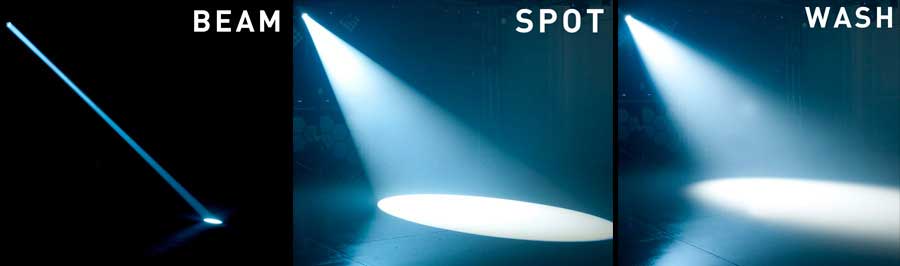
- Beam (Left): Ultra-concentrated pencil shaft (\(< 5^\circ\)) that stays tight and parallel, punching high-intensity energy into mid-air haze for aerial concert dynamics.
- Spot (Center): Well-defined optical cone (\(10^\circ - 30^\circ\)) forming a clean, sharp-edged circular pool on surfaces, ideal for gobos, logos, and highlighting soloists.
- Wash (Right): Wide, soft-edged diffused pool (\(> 25^\circ\)) that seamlessly blends with surrounding luminaires to paint the entire stage floor or scenery in even color.
2.1 Wash Moving Heads: The Industry Benchmark
Wash fixtures utilize a Fresnel-style or textured honeycomb front lens array paired with a motorized zoom assembly.
A prime example is the iconic Clay Paky A.leda B-EYE K10, featuring an array of 19 individual RGBW LEDs with a motorized front lens that can rotate to create both smooth wide washes and vortex kaleidoscope patterns:

2.2 Inside a Moving Head: Colors & Gobos
Inside a modern Spot or Beam luminaire, motorized wheels rotate optical elements directly into the path of the light beam:

- Color Wheels & Dichroic Filters: A thin metal disc containing circular dichroic glass filters (red, green, blue, yellow, magenta, cyan, orange). As the wheel spins, the beam snaps between colors or rests halfway between two filters to create a split-color beam.
- Gobo Wheels: A carousel disc fitted with circular pattern templates called gobos (from "Go Between Optics"):

When light passes through a gobo, it projects sharp graphic textures, leafy foliage breakups, or corporate logos onto the stage floor. On higher-end spots, individual gobos rotate independently on their own axes, allowing rotating water ripples or spinning star patterns.
- Prisms: Multi-faceted glass elements (e.g. 3-facet circular or 6-facet linear) that insert into the beam to split a single gobo projection into a radiating cluster of shapes.
2.3 Profile Luminaires & Framing Shutters
In theater, television studios, and corporate conventions, circular spotlights often spill light where it is not wanted—such as onto a giant projection screen or outside a scenic doorway.
Profile fixtures solve this with framing shutters. Notice the four protruding metal adjustment handles located around the central collar (optical gate) of this theatrical profile fixture:

By pushing or angling these four independent steel shutter blades, you slice the beam into crisp geometric polygons: a sharp rectangle that illuminates a CEO at a podium without spilling onto the LED screen behind them, or a precise trapezoid matching a scenic staircase.
3. Practical Rigging Placement Guide
When planning where to mount fixtures on your lighting trusses, use this practical placement strategy:
| Rig Position | Recommended Fixture Types | Why This Works |
|---|---|---|
| Front Truss (Downstage) | Wash heads, Profile spots, LED PARs | Provides clean, flattering illumination on performer faces and bodies from the front without blinding them at eye level. |
| Mid-Stage Overhead Truss | Spot heads with gobos, Wash heads | Projects textured patterns onto the stage floor and provides overhead backlight pools over musicians and backline gear. |
| Back Truss (Upstage Overhead) | Beam heads, Spot heads, Audience Blinders | Pierces through the air canvas forward toward the crowd for dramatic aerial sweeps; blinders point straight out to engage the audience during choruses. |
| Stage Floor (Upstage / Sides) | LED Bars, Floor Beams, Compact PARs | Grazes upward along backdrops; shoots vertical light columns behind drummers and guitarists to create strong silhouettes. |
📝 Self-Assessment Quiz
Think through these real-world scenarios to check your understanding:
-
Scenario A: You are lighting a corporate conference where a CEO speaks on stage directly in front of a giant 4K LED video screen. Every time you turn on your front spotlights to light the CEO, the light spills onto the screen and washes out the presentation slides. Which luminaire feature solves this problem?
- A) A wider zoom on a Wash fixture
- B) Motorized framing shutters on a Profile fixture
- C) An 8-facet rotating prism on a Spot fixture
- D) An audience blinder mounted on the floor
-
Scenario B: A venue manager has zero atmospheric haze or fog machines and strictly forbids using them because of sensitive fire sensors. A touring band insists on renting 12 narrow Beam moving heads (2° beam angle) to create "epic aerial shafts" over the stage. Will this achieve the band's desired visual effect? Why or why not?
-
Scenario C: You need to light a 5-piece rock band on a small club stage so that the lead singer, bassist, and guitarist are evenly covered in saturated blue light without harsh shadow lines between them. Would you choose 4 Spot heads or 4 Wash heads?