The Step Animation Editor is Unilighter's engine for creating sequential chases, rhythmic color pulses, alternating strobe bursts, and multi-scene step sequences. Unlike continuous keyframe timelines, Step Animations operate on discrete lighting states (steps) that hold for a defined duration or musical beat before crossfading to the next step.
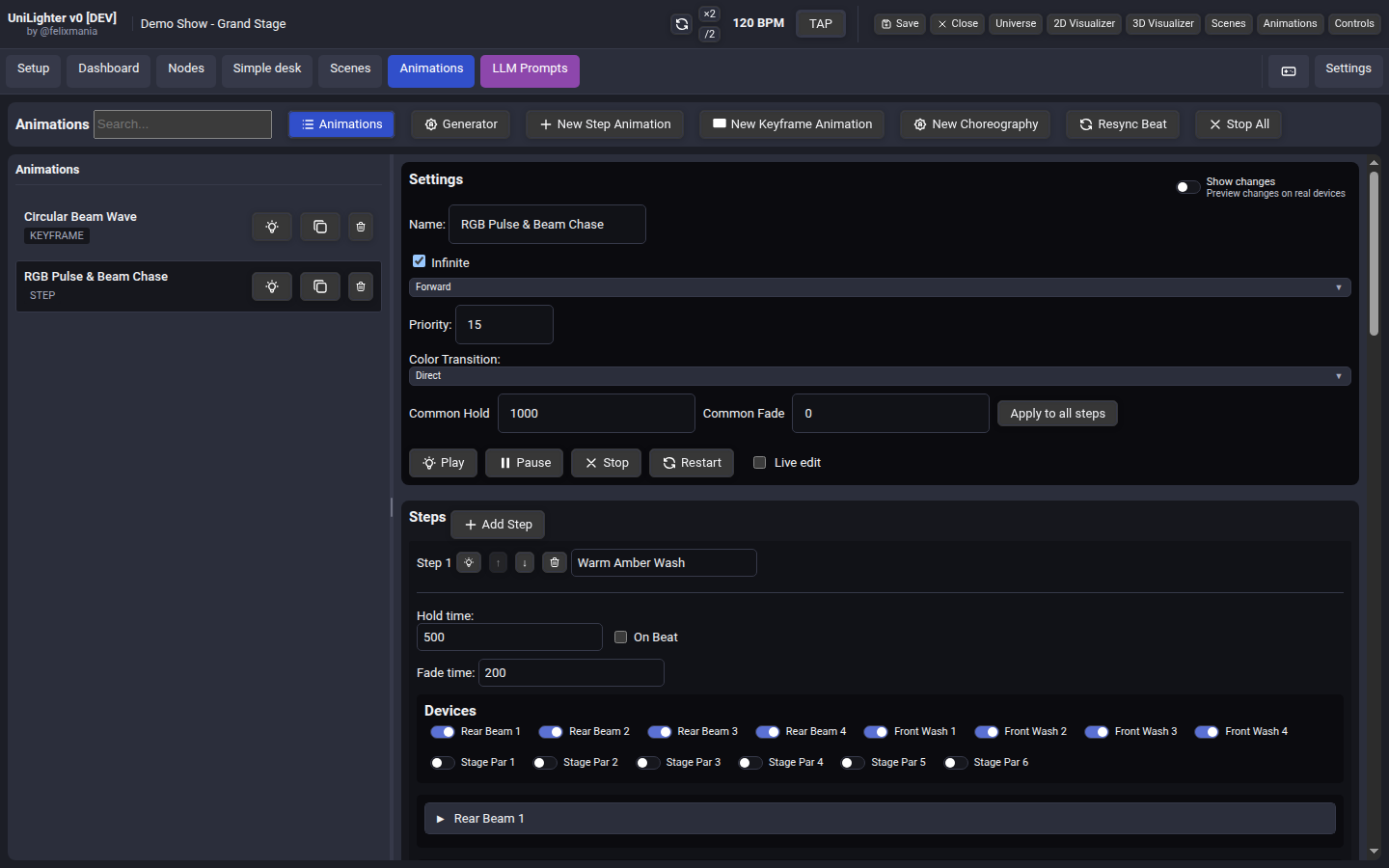
⚙️ Global Animation Settings
Each Step Animation features global properties that govern playback order, priority layering, and color blending:
1. Name & Control Priority
- Name: A descriptive title (e.g.,
Odd/Even Wash Chase,RGB Strobe Pulse). - Priority (
-100to100): Sets the animation's authority in the Unilighter Priority System. An animation set to priority15will seamlessly override static background scenes (Priority: 0), while allowing manual faders on the Live Dashboard (Priority: 100) to take precedence when touched.
2. Repeats & Infinite Playback
- Infinite Checkbox: When checked, the animation loops continuously until stopped or superseded by another cue.
- Repeats: If unchecked, define a precise number of cycles (e.g.,
3cycles for a brief strobe burst) before the animation automatically halts.
3. Playback Order
Choose how the engine iterates through your sequence of steps:
- Forward: Steps sequence strictly from start to finish (
1 → 2 → 3 → ... → N → 1). - Reverse: Steps run backward (
N → ... → 3 → 2 → 1 → N), ideal for reversing beam sweep directions. - Ping-Pong: Steps bounce back and forth smoothly (
1 → 2 → 3 → 2 → 1), creating natural pendulum or waving movements.
4. Color Transition Modes
When steps feature contrasting fixture colors, Unilighter provides four mathematical transition algorithms:
- Direct (Shortest Path): Straight-line RGB/CMY interpolation through vector color space. Fastest and most efficient for rapid color bumps.
- Hue (Linear HSV): Rotates around the perimeter of the HSV color wheel. Colors travel smoothly through adjacent spectral shades (e.g., Red to Green travels through Orange and Yellow).
- Via White: Interpolates color intensity through peak white saturation before reaching the destination hue. Produces a punchy, flash-style transition popular in electronic music sets.
- Via Black: Fades fixture dimmer down to complete blackout before bringing up the target color. Prevents muddy intermediate colors and creates classic theatrical cut transitions.
5. Bulk Timing Tools
- Common Hold (
ms): Global hold duration applied across all steps. - Common Fade (
ms): Global crossfade time applied across all steps. - Apply to all steps: Single-click button that stamps
Common HoldandCommon Fadeinto every step in the list, saving tedious manual typing.
6. Transport & Live Auditioning
- Transport Bar: Dedicated buttons for Play, Pause, Stop, and Restart.
- Live Edit: When checked, any adjustments made to step parameters or fixture sliders immediately stream to physical DMX outputs, letting you dial in positions and colors live on stage.
- Show Changes: Toggle real-time hardware preview without altering the main stage playback state.
🪜 Managing Animation Steps
The lower half of the editor contains the step sequence:
Adding & Reordering Steps
- Add Step: Appends a new step to the end of the sequence.
- Reorder (
↑/↓): Move steps earlier or later in the chase. - Preview Step (
Lighticon): Solo-audition a specific step on stage fixtures without running the entire animation loop. - Step Name: Assign custom labels (e.g.,
All Odd On,Even Blinders,Strobe Drop). - Delete (
Trashicon): Remove redundant steps.
Step Timing Parameters
Each step contains independent timing controls:
- Hold Time (
ms): The duration the step remains static after fading in. - On Beat Checkbox: When checked, hold time automatically locks to 1 musical beat (
0 mshold offset) synchronized with the master BPM clock. As tempo changes during a live performance, the chase automatically speeds up or slows down in perfect lockstep. - Fade Time (
ms): The crossfade transition time taken to morph from the previous step's values into this step. Set to0for instantaneous snap cuts (strobe/blinder chases), or higher values (200ms - 2000ms) for gentle ambient morphing.
Embedded Scene Editor
Clicking any step opens an embedded Scene Editor containing:
- Device Selector Chips: Enable or disable specific fixtures (
Rear Beam 1,Stage Wash 2,Stage Par 3) in this step. - Parameter Controls: Adjust Dimmer faders, RGB/CMY color wheels, Pan/Tilt position crosshairs, and indexed gobo/prism wheels.
- Selective Overrides: Only active channels within a step are sent to DMX. Untouched channels pass through signals from lower-priority layers.
🪄 Rapid Creation with Animation Generator
Instead of programming steps by hand, use the built-in Generator tab:
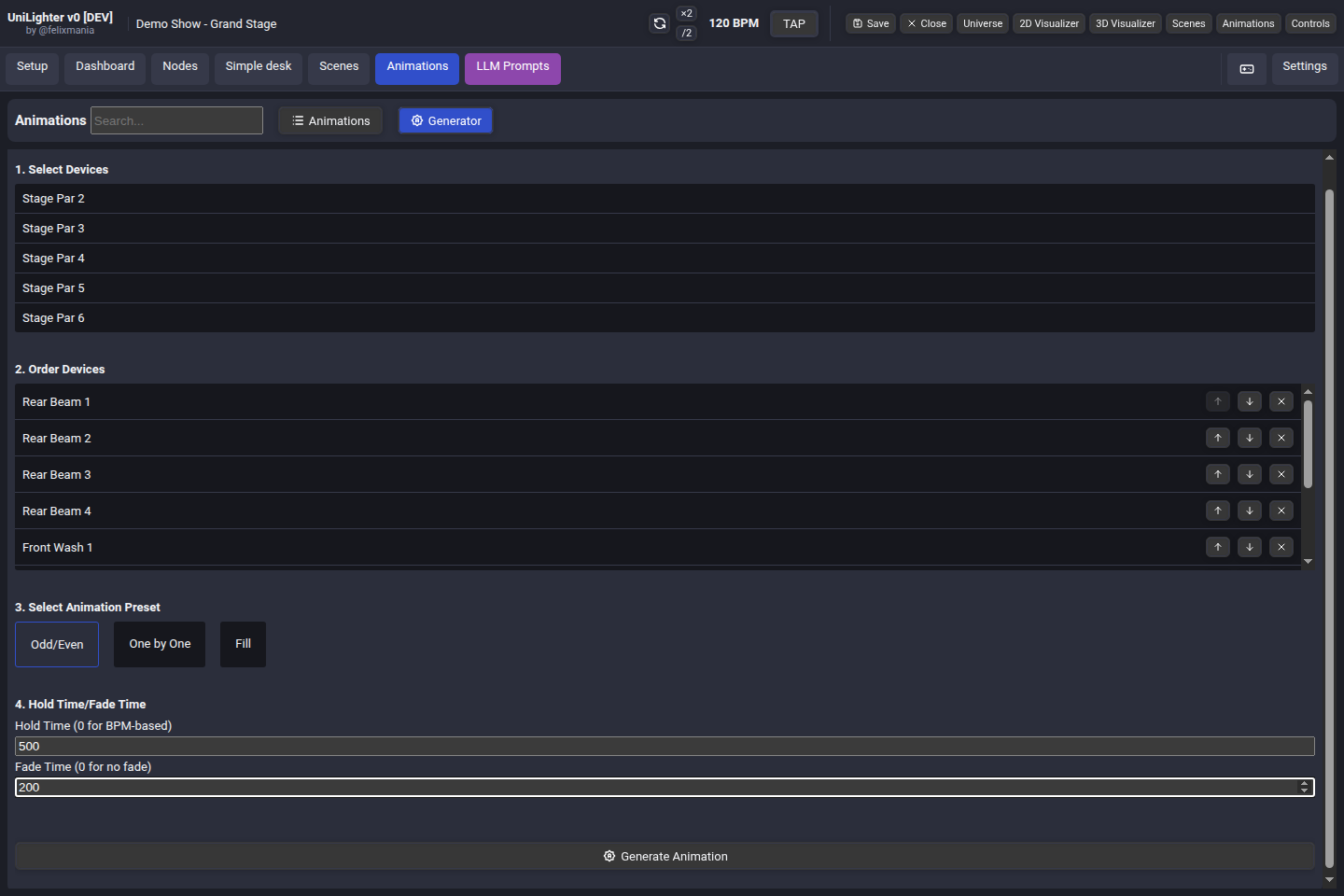
- Select Devices: Click fixtures from the device list to include them in the chase.
- Order Devices: Arrange physical left-to-right, center-out, or circular ordering using the
↑,↓, and remove buttons. - Select Preset:
- Odd / Even: Creates an alternating 2-step chase where odd-numbered fixtures illuminate in Step 1 and even-numbered fixtures illuminate in Step 2.
- One by One: Creates an \(N\)-step sequence illuminating exactly one fixture at a time in sequence across the array.
- Fill: Sequentially accumulates fixtures step-by-step until all heads are illuminated, then snaps off and repeats.
- Hold & Fade Times: Specify default hold time (or enter
0for beat-synchronized playback) and fade time. - Generate Animation: Click the button to automatically bake all steps and scenes into a new Step Animation ready for playback.
🎛️ Live Performance Integration
Once saved, Step Animations can be triggered seamlessly:
- Function Widget on Dashboard: Map the animation to a touch button for instant cue firing.
- Resync Beat: Click Resync Beat in the console header at any time to instantly phase-align running chases to the DJ's downbeat.