The landscape of stage lighting has shifted dramatically toward multi-emitter fixtures. Modern rigs are packed with LED pixel bars (e.g. 16-cell battons), moving head wash lights with concentric LED rings and center spot emitters, dual-tilt moving heads, and high-density strobe panels.
On traditional lighting consoles, accommodating multi-cell fixtures is notoriously frustrating: operators are forced to either patch 16 separate single-channel fixtures (cluttering the patch list and losing global pan/tilt control) or treat the fixture as a single coarse lamp (losing pixel mapping).
Unilighter solves this with a native Multi-Head Architecture that treats complex multi-emitter fixtures as unified, intelligent single-device containers.
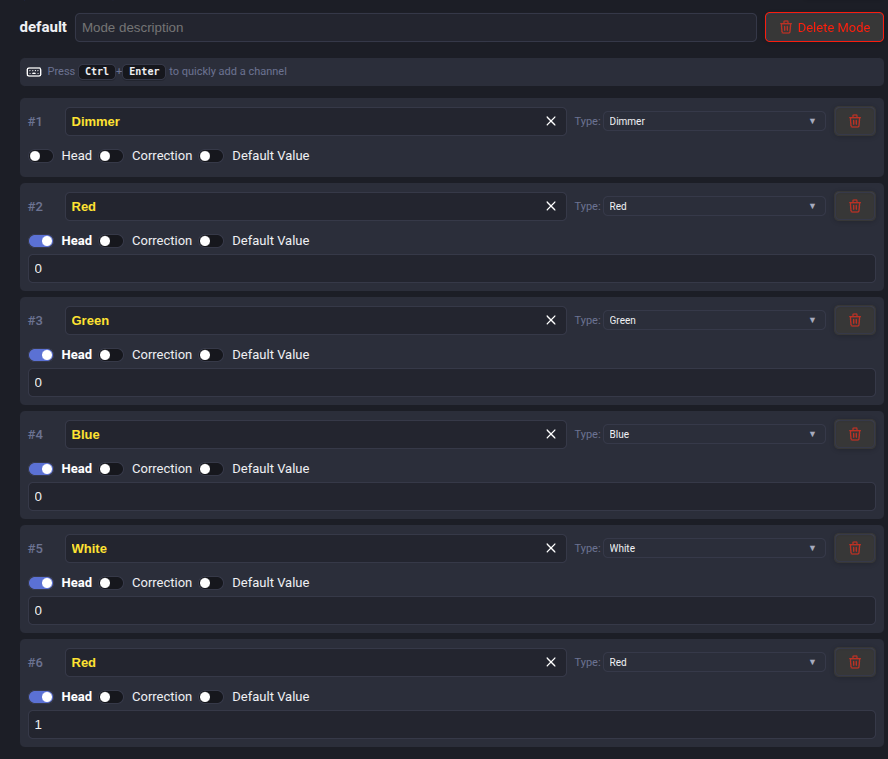
🧱 The Single-Container Model
When you patch a 16-cell pixel bar or a ring-wash moving head in Unilighter:
- You patch exactly one device in your patch list.
- Unilighter allocates the entire continuous DMX footprint automatically.
- All internal sub-emitters (heads) remain individually controllable while sharing master fixture attributes.
🔀 SHARED_HEAD vs. Independent Emitters
Unilighter partitions fixture channels into two distinct scopes:
1. The Shared Head (SHARED_HEAD = -1)
Channels assigned to the shared scope govern global physical attributes of the fixture housing:
- Master Dimmer & Strobe: Controls total luminous output across all heads simultaneously.
- Pan / Tilt & Pan/Tilt Fine: Physical mechanical motor orientation.
- Optics & Mechanics: Global Zoom, Focus, Frost filter, and Gobo wheels.
- Built-In FX & Macros: Internal fixture chase macros and speed controls.
2. Independent Heads (H0, H1, ... Hn-1)
Channels assigned to specific head indices represent localized, independent emitters:
- Cell Colors: Independent \(R, G, B, W\) channels for each individual lens or pixel diode.
- Cell Dimmers: Dedicated intensity channels per pixel (if supported by fixture mode).
- Secondary Pan/Tilt: Independent tilt angles on dual-head moving bars.
💡 Intelligent Dimmer Inheritance & Multiplied Output
A major advantage of Unilighter's multi-head engine is its hierarchical intensity resolution:
\($\text{Effective Intensity} = \text{Master Shared Dimmer} \times \text{Head Cell Dimmer}\)$
- Blackout with One Fader: Bringing down the master fixture dimmer gracefully fades out all 16 heads at once, without clearing or altering individual pixel color patterns.
- Fallback Dimming: If a multi-head fixture profile does not have per-pixel dimmers, Unilighter automatically maps the master dimmer across all heads.
- Per-Head Color Calibration: Each individual head can have independent color correction applied in Color Engine, ensuring uniform whites across every cell of a pixel batton.
🏷️ Tagging & Targeting Multi-Head Fixtures
Unilighter's Fixture Tags and parameter selectors seamlessly address both global fixtures and localized heads:
- Targeting All Heads: Selecting
#StageBarsin a color picker sets all pixels on all patched bars simultaneously. - Targeting Shared Parameters: In Keyframe Animations or Node Graphs, binding to
pan (Shared)moves the physical bar while leaving pixel color chases untouched. - Targeting Specific Heads: You can isolate sub-emitters (e.g.
#StageBars.h0for the first pixel of every bar, or the outer LED ring of a wash head) to generate intricate geometric chases.
🌐 2D & 3D Stage Visualizer Integration
In Unilighter's built-in 2D Stage Layout and 3D Visualizer, multi-head fixtures are rendered with accurate physical spacing:
- Each pixel cell emits light from its true spatial coordinate along the fixture bar.
- When the fixture moves in Pan or Tilt, all child heads rotate cohesively in 3D space.
Read more in the Device Patch & Universe Setup Manual and the Fixture Profile Editor.