Lesson 1.2: Atmospheric Dynamics: Hazers vs. Fog Machines
Every lighting technician has seen this common mistake: a venue spends thousands of dollars renting high-power moving beams, turns them on, and discovers... nothing. The stage floor has bright circular spots on it, but the air above the stage is completely empty.
Light travels in straight lines through transparent air. Unless light photons strike something solid—an actor, a musical instrument, a wall, or microscopic particles suspended in the air—none of that light scatters into the eyes of the audience.
To reveal beams, fans of light, and aerial cone sculptures, you need an atmospheric medium. This lesson explains the difference between hazers and fog machines, how to manage airflow, and how to avoid setting off building fire alarms.
1. The Scattering Effect: Why Clean Air Hides Light
When light travels through clean air containing only nitrogen and oxygen molecules, almost zero visible scattering occurs.
When you introduce microscopic liquid droplets into the air, incoming light strikes the surface of these droplets and undergoes Mie scattering. Photons bounce off in all directions, including forward and sideways toward the audience's eyes.

The droplets transform the empty air volume into a three-dimensional visual canvas.
2. Hazers vs. Fog Machines: What Is the Difference?
Technicians often confuse fog machines with hazers. They use different mechanical principles and serve completely opposite production roles:
| Characteristic | Atmospheric Hazer | Fog Machine (Smoke Generator) |
|---|---|---|
| Visual Appearance | Ultra-fine, nearly transparent, uniform mist | Thick, opaque, billowy white clouds |
| Primary Production Role | Revealing aerial light beams while keeping performers clearly visible | Dramatic bursts, spooky graveyard scenes, grand entrances |
| Droplet Size | Extremely small (0.5 to 2 microns) | Large (10 to 50 microns) |
| Hang Time in Air | Long (1 to 4 hours in closed venues) | Short (dissipates within 1 to 5 minutes) |
| Audience Visibility | Stage and performers remain 100% visible | Temporarily blocks line of sight entirely |
2.1 Atmospheric Hazers
A hazer runs continuously or on gentle low-percentage duty cycles throughout the performance. Its job is to create a thin, homogeneous atmosphere across the entire room. When dialed in correctly, the audience does not perceive "smoke"—they simply see crisp, solid shafts of light cutting through space.
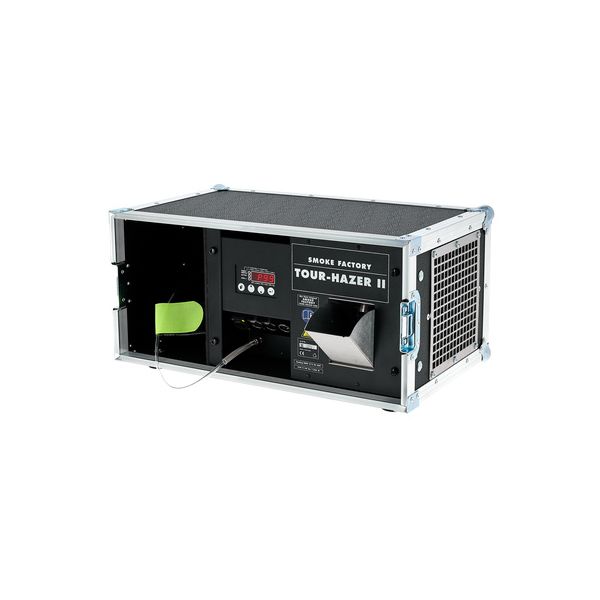
- Water-Based Hazers (Glycol / Glycerin):
- Uses pharmaceutical-grade food glycol mixed with distilled water.
- Leaves zero oily residue on camera lenses, moving head mirrors, or venue curtains.
- Dissipates slightly faster than oil; typically kept running on low output throughout the entire concert.
- Oil-Based Hazers (Mineral Oil / Cracked Oil):
- Uses compressed air or ultrasonic pumps to break highly refined cosmetic mineral oil into sub-micron droplets.
- Produces exceptional hang time: a 10-minute burst can keep beams visible for 3 to 4 hours in a quiet hall.
- Trade-off: Over long tours or enclosed venues with poor ventilation, fine oil deposits can accumulate on fixture fans, cooling heatsinks, and camera optics.
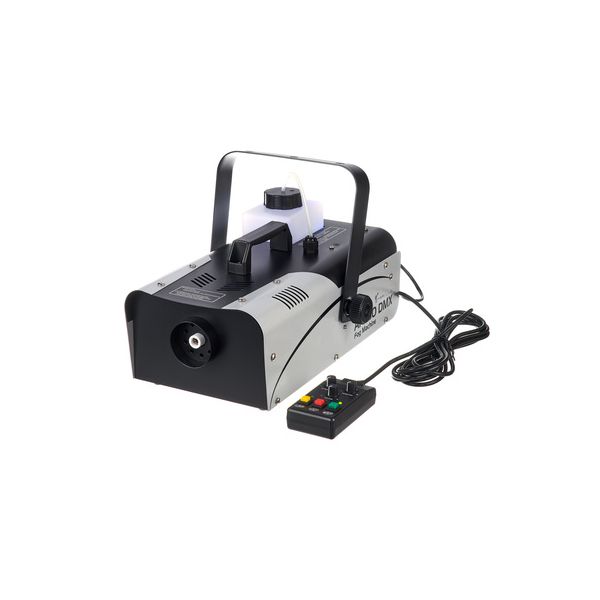
2.2 Fog Machines (Smoke Generators)
A fog machine pumps fluid through a heated heat exchanger block (typically 200°C to 300°C), vaporizing the fluid into a dense, expanding cloud. It is designed for high-impact momentary effects:
- A blast of white smoke behind a lead guitarist during a solo.
- Low-Lying Fog (Chilled Smoke): Smoke passed through a cooling chamber (chilled with dry ice, liquid CO2, or mechanical refrigeration). The cold smoke becomes denser than the warm room air, hugging the floor for "dancing on clouds" wedding moments or swamp scenes without rising above knee height.
3. The Fire Alarm Hazard: Types of Smoke Detectors
Triggering a fire alarm during a sold-out concert is every technician's worst nightmare: emergency sirens sound, house lights snap to full white, stage power cuts, and the fire department arrives.
Before turning on any atmospheric machine, you must know what type of fire sensors protect the ceiling:
| Sensor Type | Operating Principle | Reaction to Haze & Fog |
|---|---|---|
| Optical (Photoelectric) | Uses an infrared LED and light sensor inside a dark chamber. | ⚠️ Extremely sensitive! Scattered haze droplets bounce light onto the sensor, immediately triggering false alarms. |
| Ionization Sensors | Uses a tiny radioactive source to ionize air molecules between electrodes. | ⚠️ Moderately sensitive. Heavy fog disrupts ion flow and can trip the sensor. |
| Rate-of-Rise Heat Detectors | Measures physical ambient temperature and rapid thermal spikes. | ✅ 100% immune to haze. Only triggers from actual fires and high heat. |
Protocol for Venues:
- Never assume it is safe to haze: Always speak to the building facilities manager or house electrician before plugging in a machine.
- Isolate Stage Alarm Zones: Modern building alarm systems allow technicians to place specific stage-area smoke sensor loops into "Test" or "Bypass" mode for a set duration (e.g. 4 hours), while keeping sprinkler systems and emergency exits fully active.
- Fire Watch: Many jurisdictions mandate assigning a designated crew member as a dedicated "fire watch" while smoke sensors are isolated.
4. Practical Fan Placement & Air Circulation
A common mistake is aiming a hazer straight down the center of the stage. The fluid forms an ugly, dense localized cloud right in front of the singer while the rest of the stage remains completely clear.
The Directional Fan Technique:
- Place your hazer upstage in a corner or behind a backline amplifier.
- Place a directional stage drum fan (set to low or medium speed) directly behind or above the hazer exhaust nozzle.
- Angle the fan upward toward the ceiling or toward the side walls.
- The high-volume low-velocity airflow catches the concentrated exhaust vapor and disperses it into a uniform, room-wide mist that circulates gently with the room's natural convective airflow.
📝 Self-Assessment Quiz
Think through these real-world scenarios to check your understanding:
-
Scenario A: You arrive at a historic theater for a concert. The building manager informs you that the ceiling directly over the stage has optical photoelectric smoke detectors that cannot be isolated. What will happen if you run a water-based hazer on medium output during soundcheck?
-
Scenario B: A video production company is shooting a television commercial inside a small studio with expensive broadcast camera lenses and teleprompters. The director wants to see subtle light beams from two spotlights. Would you recommend an oil-based hazer or a water-based hazer? Why?
-
Scenario C: During a live gig, the drummer complains that thick clouds of haze are blowing directly into their face and making it hard to see the setlist, while the guitarists on stage right have zero visible light beams. What simple equipment adjustment will fix this problem?