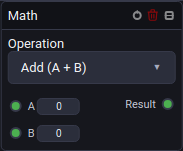
The Math Node (MathNode) provides a high-performance numerical calculation and signal conditioning engine, supporting basic arithmetic, logical bounding, range mapping, custom JavaScript mathematical expressions, and multi-element sequence processing.
🧮 Numeric & Sequence Polymorphism
The Math Node operates as a numeric-polymorphic processor across both scalar numbers and sequences:
- Scalar Operations: When all connected inputs are scalar numbers, the result is a scalar number.
- Sequence Vectorization: When any input is a sequence (array of numbers), the operation produces an output sequence whose length matches the longest input sequence.
- Scalar Broadcasting: Single scalar inputs are automatically broadcast to every element of the sequence (e.g.
[1, 2, 3] * 0.5yields[0.5, 1, 1.5]). - Cyclic Sequence Alignment: Shorter sequences automatically repeat cyclically to fill the length of the longest sequence (e.g.
[1, 2] + [10, 20, 30, 40]yields[11, 22, 31, 42]). - Empty Sequence Handling: If any connected sequence input is empty, the calculation produces an empty sequence output.
⚙️ Operation Modes
1. Basic Arithmetic
Add (A + B): Sum two signals (e.g. adding a scalar baseline offset to an oscillator sequence).Subtract (A - B): Subtract signal B from A.Multiply (A × B): Amplitude scaling (e.g. Master Dimmer multiplying a chasing wave sequence).Divide (A ÷ B): Frequency scaling or ratio calculations.Power (A ^ B): Exponential curves for perceptual LED brightness correction.
2. Logic, Clamping & Bounding
Minimum / Maximum: Limit signals to lowest or highest peak.Mean: Average between two inputs or sequences.Blend (A to B): Crossfade between signals using a float weight (0.0 – 1.0).Clamp (Min/Max): Constrains output strictly between lower and upper boundaries.Map Range: Linearly maps an input range (fromMin..fromMax) to a target range (toMin..toMax).
3. Custom JavaScript Equations
Select Custom Equation to evaluate arbitrary mathematical expressions using native JavaScript:
- Per-Element Evaluation: Custom equations are evaluated once for each element in the resulting sequence.
- Scalar Element Variables:
a,b,factor,min,max,fromMin,fromMax,toMin,toMaxprovide the current scalar values for elementi. - Index & Length Variables:
i: Zero-based index of the current element (0, 1, 2, ..., n - 1).n: Total length of the result sequence.
- Full Sequence Access:
seq.<name>exposes full normalized input sequences. For example,seq.agives access to the entire array of inputA:// Cyclic spatial neighbor modulation a + seq.a[(i + 1) % n]
// Index-based phase progression Math.sin(a Math.PI 2 + (i / n) Math.PI) 0.5 + 0.5
> [!NOTE]
> Custom equations must return a finite number for each element. Non-finite or invalid results evaluate to zero and flag the equation as invalid in the UI.

---

## 🔌 Sockets Reference

| Socket | Direction | Data Type | Description |
| :--- | :--- | :--- | :--- |
| **A** | Input | `Number` / `Sequence` | Primary operand (scalar or sequence). |
| **B** | Input | `Number` / `Sequence` | Secondary operand (scalar or sequence). |
| **Result** | Output | `Number` / `Sequence` | Calculated scalar number or polymorphic sequence. |