Lesson 6.2: The Production Sync Rig: Syncing Audio, Lights, Video & Pyro
Warning
⚠️ Draft Lesson: This lesson is currently a working draft and is undergoing practical review. Technical labs, workflows, and diagrams may be expanded and refined in upcoming revisions.
During an arena concert tour, the audience sees a seamless spectacle: at the exact millisecond a cymbal crashes, 200 moving lights strobe white, an LED video wall splits into three-dimensional graphics, laser beams shoot across the arena, and two flame jets shoot twenty feet into the air.
Behind this spectacle lies a complex multi-department distribution network known in touring as the Production Sync Rig.
In this lesson, we break down how touring playback rigs generate and distribute audio, click tracks, and timecode, explore dual-redundant failover switchers, and examine the critical human safety protocols governing pyrotechnics and lasers.
1. The Touring Playback Engine: Who Owns Timecode?
In ninety-five percent of touring productions, the master timecode clock originates not with the lighting designer, but with the Playback Engineer (or the Drummer / Musical Director) stationed backstage or on the band riser.
The playback system runs a professional Digital Audio Workstation (DAW)—most commonly Ableton Live, Avid Pro Tools, or Cockos Reaper—connected to a multi-channel touring audio interface.
+-------------------------------------------------------------------------+
|                  TOURING PLAYBACK AUDIO CHANNEL LAYOUT                  |
+-------------------------------------------------------------------------+
|                                                                         |
|  [Playback Computer (Ableton Live / Pro Tools)]                         |
|    │                                                                    |
|    ▼ (Multi-Channel Audio Interface)                                    |
|    ├── Out 1 & 2: Stereo Backing Tracks ────> Front of House PA Mixer   |
|    ├── Out 3: Band Click Track (Metronome) ─> Drummer & Band In-Ear IEM |
|    ├── Out 4: Slate / Guide Vocal ("Verse 2")> Band In-Ear IEM Monitors |
|    └── Out 5: SMPTE LTC Audio Timecode ─────> Production Sync Racks     |
|                                                     │                   |
|         ┌───────────────────┬───────────────────────┼──────────────┐    |
|         ▼                   ▼                       ▼              ▼    |
|   [Lighting Desk]   [Video Media Server]   [Laser Controller]  [Pyro]   |
|    (Unilighter)      (Disguise/Resolume)    (Pangolin Beyond)   (Show)  |
+-------------------------------------------------------------------------+
The Multi-Channel Distribution Breakdown:
- Tracks 1 & 2 (Master Music Stems): Stereo synthesizers, orchestral layers, sub-bass drops, and secondary backing vocals routed directly to the FOH audio console for the audience.
- Track 3 (Click Track): An isolated metronome click routed exclusively into the band's wireless In-Ear Monitors (IEMs), keeping the live drummer locked in tempo with the digital backing tracks.
- Track 4 (Guide / Slate Cues): A spoken vocal guide heard only by the performers ("Verse in 4... 3... 2... 1...", "Guitar Solo coming up"), ensuring the band never misses an arrangement cue.
- Track 5 (SMPTE LTC Timecode): Continuous analog audio timecode transmitted to lighting, video, laser, and pyrotechnic systems.
2. Dual-Redundant Auto-Switching Rigs
On a multi-million-dollar stadium tour, playing to 50,000 fans, the playback computer must never fail. If a laptop crashes mid-song, the backing music stops, the click track dies, the band gets confused, and the lights freeze.
To prevent this catastrophe, touring productions deploy Dual-Redundant Playback Rigs:
[ Primary Laptop A (Ableton) ] ────┐
                                   ├──> [ Hardware Auto-Switcher ] ──> [ Show Output ]
[ Backup Laptop B (Ableton) ]  ────┘    (e.g. Radial SW8 / iConnectivity)
How Hardware Auto-Switchers Work:
- Lockstep Playback: Two identical computers (Rig A and Rig B) run identical project files. When the operator hits play, both computers start playing simultaneously in perfect sync.
- The Pilot Tone: Rig A outputs an inaudible high-frequency test tone (typically a \(1\,\text{kHz}\) or \(10\,\text{kHz}\) sine wave on an unused channel) into the auto-switcher (such as a Radial SW8 or iConnectivity PlayAUDIO).
- Instantaneous Failover: If Computer A crashes, freezes, drops a USB buffer, or loses power, the pilot tone stops.
- The auto-switcher detects the absence of the pilot tone in less than \(10\,\text{milliseconds}\) and snaps internal mechanical relays to Computer B.
- The audience hears zero audio interruption, and timecode continues streaming seamlessly to the lighting desk!
3. Unilighter Synchronization & Bindings Architecture
In Unilighter, incoming sync signals, timecode events, and hardware controller triggers are managed through the Bindings Manager:
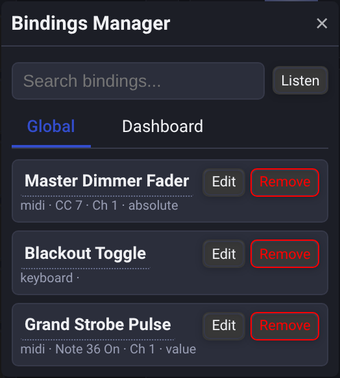
Inside the Bindings Manager:
- Timecode Clock Source: Select between incoming MTC (MIDI Timecode), SMPTE LTC Audio, or Network ArtNet Timecode.
- Offset Calibration: Apply a millisecond offset (e.g. \(+25\,\text{ms}\)) to compensate for projector processing latency or acoustic sound travel delay across large venues.
- Trigger Routing: Map specific timecode milestones to cue lists, scene snapshots, or generative node graph macros.
4. The Safety Chain: Why Pyro and Lasers Differ from Lighting
When automating a show via timecode, there is a fundamental dividing line between non-hazardous and hazardous visual elements:
+-------------------------------------------------------------------------+
|                  NON-HAZARDOUS vs. HAZARDOUS CUES                       |
+-------------------------------------------------------------------------+
|                                                                         |
|  💡 NON-HAZARDOUS (Full Automation Allowed)                             |
|  - Stage Lighting (Moving heads, blinders, strobes, washes)             |
|  - Video Displays (LED walls, projectors, media servers)                |
|  * If a lighting cue fires early or late, nobody gets physically hurt.  |
|                                                                         |
|  🔥 HAZARDOUS (Human Dead-Man's Safety Switch MANDATORY)                 |
|  - Pyrotechnics (Mines, gerbs, concussions, stage comets)               |
|  - Flame Projectors (Liquid fuel and propane fire jets)                 |
|  - High-Power Class 4 Aerial Lasers                                     |
|  * A mistake or performer out of position can cause fatal injury!       |
+-------------------------------------------------------------------------+
The Golden Rule of Stage Pyrotechnics (NFPA / ESTA Standards)
Caution
Timecode commands WHEN to fire; the Human Operator determines IF it is safe to fire.
In compliance with international entertainment safety regulations (NFPA 1126, ESTA ANSI E1.43):
- Never Fully Automate Hazardous Pyro: Pyrotechnic firing computers receive timecode and arm the cue for the exact downbeat.
- The Physical Dead-Man's Switch: A licensed, alert Pyrotechnic Safety Officer holds a physical, spring-loaded deadman button with an unobstructed line of sight to the stage.
- The Abort Protocol: If an artist, dancer, or cameraman accidentally stumbles into the safety zone (e.g. within 3 meters of a flame head), the safety officer releases the deadman switch. The circuit breaks instantly, preventing the flame jet from firing even though the timecode cue just fired!
Lighting programmers must maintain active communication with the pyrotechnic team during rehearsals, ensuring that blinder hits and flame blasts coordinate aesthetically without compromising safety boundaries.
5. Hands-On Lab: Designing a Touring Sync Diagram
Follow this architectural exercise to map out a complete touring synchronization workflow:
Step 1: Define the Master Clock
- Playback Software: Ableton Live
- Master Frame Rate: \(25\,\text{fps}\) (European Standard)
- Transmission: SMPTE LTC down an analog balanced audio line
Step 2: Establish Song Timecode Offsets
Organize your show file using the standard hour-per-song convention:
- Song 1 ("Opening Track"): Starts at
01:00:00:00 - Song 2 ("High Energy Single"): Starts at
02:00:00:00 - Song 3 ("Acoustic Ballad"): Starts at
03:00:00:00 - Song 4 ("Encore Climax"): Starts at
04:00:00:00
Step 3: Define Department Distribution
- Output 5 of the playback rack routes into an active analog audio distribution amplifier (press box).
- Line 1 \(\to\) Lighting Console (Unilighter LTC In).
- Line 2 \(\to\) Video Media Server (Disguise / Resolume LTC In).
- Line 3 \(\to\) Laser Control Rig (Pangolin Beyond LTC In).
- Line 4 \(\to\) Pyro Master Firing Desk (with human safety deadman enabled).
By architecting this clean distribution before arriving at the venue, all four visual departments hit their cues simultaneously on Beat 1 of the first song with zero guesswork.
📝 Self-Assessment Quiz
Test your comprehension of production sync rigs, playback redundancy, and safety protocols:
- Scenario A: During an arena concert tour, an automated timecode cue commands four propane flame jets to fire high-energy fireballs on the opening beat of a song's chorus. Three seconds before the drop, a guitarist trips over a monitor wedge and falls directly into the flame jet's safety clearance radius. What happens?
- A) The lighting console automatically calculates an emergency DMX collision vector and changes the flame color to blue.
- B) The certified pyrotechnic safety officer instantly releases the physical, spring-loaded dead-man's switch, breaking the ignition circuit and preventing the flame jets from firing despite the incoming timecode command.
- C) The RS-485 transceiver on the DMX line overheats, blowing the circuit breaker.
- D) The playback computer automatically reverses timecode by four bars to give the guitarist time to stand up.
Correct Answer: B Why this is correct: Under international pyrotechnic safety standards (NFPA 1126), hazardous effects can never be fired solely by software automation. A human safety officer must maintain a physical deadman button and abort the cue if personnel are within the danger perimeter. Why other options are incorrect: Lighting consoles do not govern physical flame ignition safety (A); RS-485 signal transceivers do not blow mains breakers (C); and timecode cannot automatically reverse live band backing tracks (D).
- Scenario B: Why do professional touring playback engineers deploy dual-redundant auto-switchers (such as the Radial SW8) connected to two identical playback laptops running in lockstep?
- A) Because standard USB cables can only transmit odd-numbered DMX universes.
- B) Because if Computer A crashes, freezes, or loses power mid-song, the hardware detects the loss of a pilot tone and automatically switches audio and timecode to Computer B within 10 milliseconds with zero audible dropout.
- C) Because two computers are required to double the physical frame rate of SMPTE timecode from 30 fps to 60 fps.
- D) Because venue smoke alarms require dual-redundant electrical grounds to prevent accidental triggering.
Correct Answer: B Why this is correct: Redundant auto-switchers eliminate single points of failure: two identical laptops run identical sessions in sync. If the primary laptop drops its pilot tone, the hardware switcher instantly routes the backup laptop's outputs to FOH and lighting. Why other options are incorrect: USB cables carry digital data packets independent of universe numbering (A); SMPTE frame rates are standard timing specifications, not doubled by hardware (C); and smoke alarms operate on aerosol detection, not computer grounding (D).
- Scenario C: In a multi-channel touring playback setup, what is the purpose of routing a dedicated "Guide / Slate" vocal channel to the band's wireless in-ear monitors?
- A) It broadcasts the venue fire marshal's emergency announcements directly to the audience PA.
- B) It provides spoken countdowns and structural arrangement reminders (e.g. "Chorus in 4... 3... 2... 1...") so the live performers stay perfectly aligned with automated lighting and video cues.
- C) It feeds digital hexadecimal parity code into the lighting console's Simple Desk fader bank.
- D) It adjusts the optical focus of stage moving heads using acoustic beam frequencies.
Correct Answer: B Why this is correct: A guide or slate track contains spoken arrangement cues heard only by the band in their in-ears, keeping musicians aware of upcoming sections, count-ins, and solos so they hit marks in unison with automated cues. Why other options are incorrect: Slate tracks are private band monitors, not public PA announcements (A); audio vocals do not carry DMX hex code (C); and moving head optics are motor-driven, not acoustically focused (D).